


The Future of Artificial Intelligence in Business, Technology, and Innovation
Artificial Intelligence (AI) has moved far beyond experimentation. In 2026, it stands as one of the most powerful economic and technological forces shaping industries worldwide. From automation and cybersecurity to sustainability and workforce transformation, AI is no longer optional it is foundational.
Businesses that understand the top AI trends dominating 2026 will not only remain competitive but position themselves as industry leaders. This comprehensive guide explores the ten most impactful AI trends of 2026, supported by market data, research insights, and enterprise adoption patterns.
Table of Contents
Why AI Is Accelerating Rapidly in 2026
Several key factors are driving the explosive AI growth in 2026:
- Massive investments in AI infrastructure
- Rapid improvements in computing power
- Enterprise-scale adoption across industries
- Regulatory frameworks taking shape
- Demand for automation and productivity
Major technology firms are projected to invest hundreds of billions of dollars in AI infrastructure this year alone. This level of capital allocation signals confidence in AI’s long-term economic impact.
The global AI market is projected to exceed $500 billion in 2026, with enterprise adoption rates surpassing 70 percent in developed markets.
1. Agentic AI – Autonomous Systems That Take Action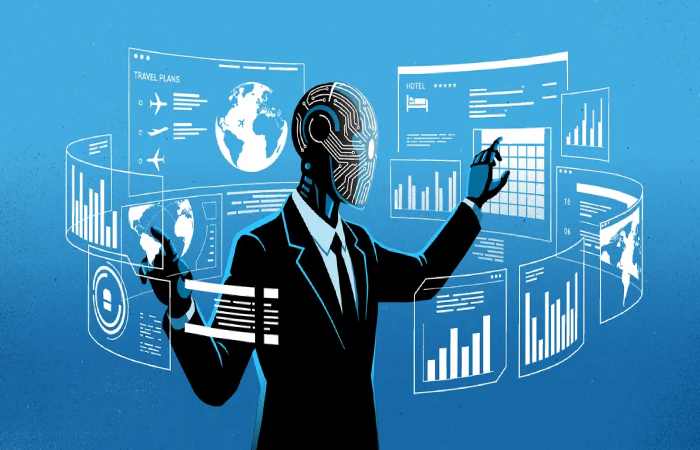
One of the most transformative developments in 2026 is the rise of Agentic AI. Unlike traditional AI systems that respond to prompts, agentic systems execute tasks autonomously.
These systems can:
- Manage workflows
- Book appointments
- Execute transactions
- Coordinate business operations
- Monitor systems and take corrective action
This shift moves AI from reactive assistance to proactive execution.
Business Impact
| Feature | Traditional AI | Agentic AI (2026) |
| Response Type | Provides answers | Executes tasks |
| Autonomy | Low | High |
| Workflow Integration | Limited | Deep integration |
| Business Value | Informational | Operational |
Agentic AI is expected to significantly reduce administrative overhead while increasing efficiency in sectors like finance, logistics, and SaaS operations.
2. Generative AI Becomes Industry-Specific
Generative AI is evolving beyond general-purpose tools. In 2026, the focus shifts to domain-specific AI systems tailored for industries such as:
- Healthcare
- Legal services
- Financial services
- Marketing
- Manufacturing
Industry forecasts suggest that by 2026, nearly 30 percent of enterprise marketing content will be AI-generated without direct human drafting.
Generative AI Applications in 2026
- Automated marketing campaigns
- AI-generated product designs
- Contract drafting in legal firms
- AI-assisted medical documentation
- Personalized customer engagement
This trend positions generative AI as a business-critical system rather than a novelty tool.
3. Multimodal AI and On-Device Intelligence
AI systems in 2026 increasingly process multiple data formats simultaneously, including:
- Text
- Images
- Video
- Audio
- Sensor data
This capability, known as multimodal AI, enables more accurate and context-aware decision-making.
At the same time, on-device AI processing is becoming more prominent. Instead of relying entirely on cloud servers, AI models now operate locally on smartphones, IoT devices, and enterprise hardware.
Benefits of On-Device AI
- Faster processing speeds
- Reduced latency
- Enhanced privacy
- Lower bandwidth requirements
- Improved security
This trend supports applications in healthcare diagnostics, smart retail, augmented reality, and real-time analytics.
4. AI Regulation and Governance Become Mandatory
As AI capabilities expand, regulatory oversight is becoming stricter. Governments worldwide are implementing AI governance frameworks focused on:
- Transparency
- Bias reduction
- Accountability
- Ethical deployment
- Risk assessment
In 2026, compliance is no longer optional. Businesses deploying AI systems must:
- Maintain audit trails
- Provide explainable outputs
- Monitor model performance
- Document training data sources
Regulatory compliance is now a competitive advantage, as trust becomes a key differentiator.
5. Edge AI and Real-Time Computing
Edge AI refers to artificial intelligence operating on local devices instead of centralized data centers.
Industries benefiting from Edge AI include:
- Manufacturing
- Healthcare
- Retail
- Transportation
- Energy
Edge AI vs Cloud AI
| Criteria | Cloud AI | Edge AI |
| Latency | Moderate | Very low |
| Data Privacy | Lower | Higher |
| Bandwidth Needs | High | Minimal |
| Real-Time Capability | Limited | Strong |
Edge AI supports applications like predictive maintenance, real-time fraud detection, and autonomous systems.
6. AI Embedded into Everyday Software
In 2026, AI is no longer an external tool. It is embedded directly into productivity platforms, CRM systems, marketing software, and collaboration tools.
Examples include:
- Email summarization tools
- Automated meeting transcription
- Intelligent scheduling assistants
- Predictive sales analytics
- AI-powered customer service bots
This embedded AI approach increases adoption because users no longer need to actively seek AI tools — they are integrated into daily workflows.
7. Physical AI and Robotics Expansion
AI is increasingly powering robotics and autonomous systems in real-world environments.
Applications include:
- Warehouse automation
- Autonomous delivery drones
- Healthcare assistant robots
- Smart manufacturing robots
- Agricultural automation
Robotics Investment Growth
| Sector | AI Robotics Adoption Growth (Estimated 2026) |
| Manufacturing | 35% |
| Logistics | 40% |
| Healthcare | 28% |
| Retail | 22% |
Physical AI enhances operational efficiency and reduces human error in complex environments.
8. AI for Sustainability and Energy Optimization
As AI adoption increases, so does its energy demand. In response, sustainability has become a major AI trend in 2026.
AI is now used to:
- Optimize energy grids
- Improve supply chain efficiency
- Reduce industrial waste
- Enhance climate forecasting
- Manage renewable energy systems
Organizations are also investing in energy-efficient AI chips and greener data centers to reduce environmental impact.
9. AI in Cybersecurity
Cyber threats are becoming more sophisticated. AI now plays a dual role in cybersecurity both defending and attacking.
AI-Driven Cybersecurity Capabilities
- Real-time threat detection
- Behavioral anomaly identification
- Automated incident response
- Fraud detection systems
- Malware pattern recognition
Cybersecurity budgets are increasing significantly as organizations adopt AI-powered defense systems to counter AI-generated attacks.
10. Workforce Transformation and AI Collaboration
AI is reshaping workforce structures. Instead of replacing jobs entirely, AI is augmenting human capabilities.
High-Demand Skills in 2026
| Skill Category | Demand Level |
| Critical Thinking | Very High |
| Data Literacy | High |
| AI System Oversight | High |
| Ethical Decision-Making | High |
| Advanced Coding | Moderate |
Professionals who learn to collaborate with AI tools will outperform those who resist automation.
AI Investment and Budget Comparison
Below is a general overview of enterprise AI solution pricing in 2026:
| AI Solution Type | Estimated Annual Cost | Primary Use Case |
| AI Agent Platforms | $20,000 – $150,000+ | Workflow automation |
| Generative AI Systems | $10,000 – $100,000 | Content and design |
| Cybersecurity AI | $50,000 – $250,000+ | Threat detection |
| Edge AI Deployment | $10,000 – $200,000 | IoT real-time analytics |
| Industry-Specific AI | $30,000 – $300,000+ | Vertical applications |
Costs vary depending on scale, customization, and infrastructure requirements.
AI market share 2026 breakdown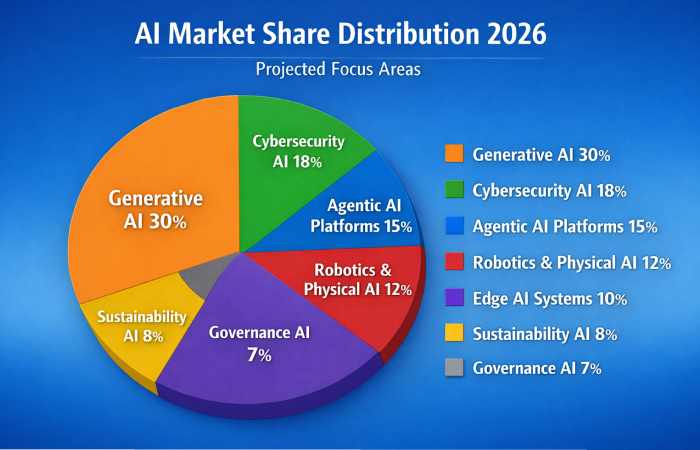
AI Market Share Distribution (Estimated 2026)
Below is an estimated distribution of AI investment focus areas in 2026:
- Generative AI: 30%
- Cybersecurity AI: 18%
- Agentic AI Platforms: 15%
- Robotics and Physical AI: 12%
- Edge AI Systems: 10%
- Sustainability AI: 8%
- Governance and Compliance AI: 7%
This distribution reflects enterprise priorities as AI becomes deeply embedded in business strategy.
Key Challenges Facing AI in 2026
Despite rapid growth, AI faces several challenges:
- Regulatory complexity
- Ethical concerns and bias mitigation
- Infrastructure scalability
- Energy consumption
- Skilled talent shortages
Organizations that proactively address these challenges will maintain stronger long-term positioning.
The Road Beyond 2026
AI development is accelerating rather than stabilizing. The next phase will likely include:
- Fully autonomous enterprise systems
- More advanced human-AI collaboration models
- AI-powered hardware ecosystems
- Stronger global AI governance frameworks
- Greater integration of AI into physical infrastructure
Artificial Intelligence in 2026 represents a turning point — where innovation meets operational reality.
Final Thoughts
The top 10 AI trends dominating 2026 highlight one clear message: AI is no longer experimental technology. It is a foundational business driver influencing productivity, security, sustainability, and global competitiveness.
Organizations that invest wisely, prioritize ethical deployment, and adapt their workforce strategies will lead the next era of digital transformation.
AI in 2026 is not simply about automation. It is about intelligent execution, responsible governance, and strategic advantage.